About Me
My research is broadly in quantum information theory. We can prove remarkable things about quantum systems—their computational advantages, communication capabilities, and fundamental limits. However, as quantum technologies scale from proof-of-concept demonstrations to practical networks, designers need more than existence proofs; they need interpretable frameworks and paradigms to better inform the design of quantum systems. I'm interested in building these connections: extracting structural patterns from quantum problems that predict which resources or paradigms are most effective, enabling designers to make informed choices rather than exhaustively testing possibilities.
I'm also committed to creating teaching environments where students develop rigorous problem-solving skills and genuine intuition for abstract systems. Having mentored hundreds of students across 5 courses at UC Irvine, I've seen how the right pedagogical approach can transform struggling students into confident problem-solvers.
I'm currently a 4th year undergraduate computer science major at UC Irvine. It is here where I've had the fortune of discovering a passion for quantum computing and theoretical computer science. I'm currently applying to CS Ph.D. programs in quantum information theory.
Outside of academics, I'm an avid hobbyist. I'm 1300 rapid Elo on chess.com, I've drawn promotional art for UCI clubs such as Euphonic Video Game Ensemble, I crochet small trinkets, play recreational badminton, poorly play piano, and love indie video games (I've been playing a lot of Hollow Knight: Silksong lately)
My Current Project
Working with Dr. Shion Fukuzawa, I'm investigating how coordination structure in quantum tasks determines which types of entanglement succeed. My framework analyzes quantum nonlocal games to extract coordination signatures (whether games rely on pairwise interactions, triple interactions, or mixed patterns) and uses these signatures to predict optimal entanglement types.
Prelminary tests across 953 three-qubit games reveals a highly convincing separation. GHZ states achieve optimal performance in 95.8% of games with pairwise coordination structure (503 of 525 games), while W states succeed in 98.3% of games requiring triple or mixed coordination (421 of 428 games). We're now extending this work toward a general classification framework and exploring robustness under realistic noise conditions.
The figures on the right show visual clusters of regimes and strategies on all 953 games plotted by pairwise and triple energy. The clusters for regimes strongly correlate with the clusters for strategies.
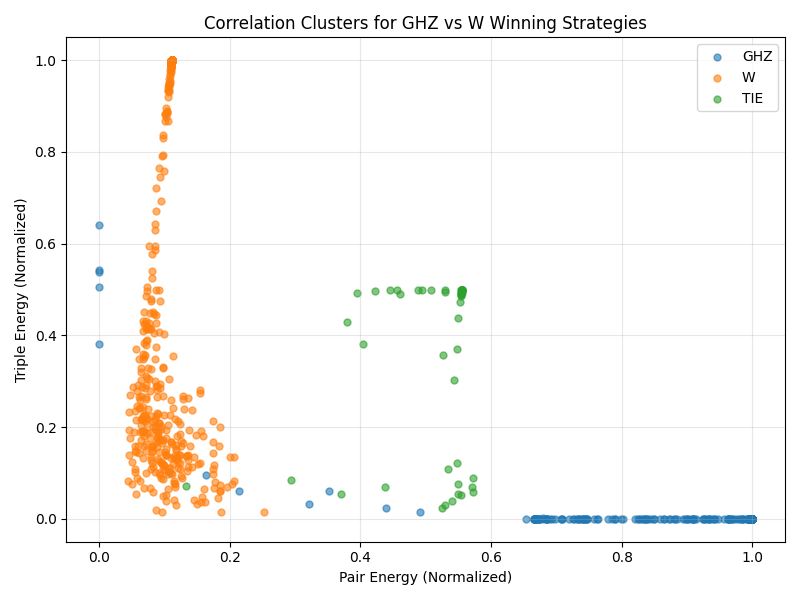
Correlation clusters for GHZ vs W winning strategies.
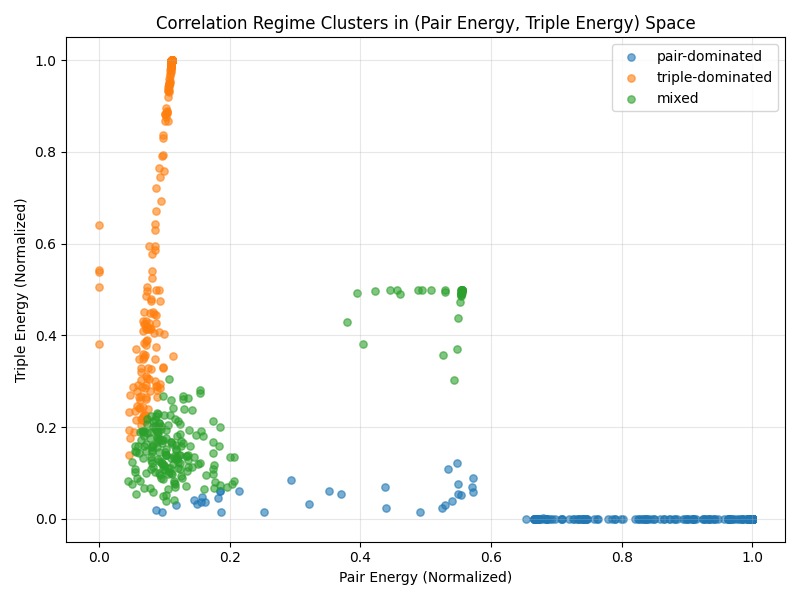
Graph of correlation regime clusters.
Teaching Experience
"If you cannot explain something in simple terms, you don't understand it"
- Richard Feynmann
Over the past three years, I've taught and mentored over 2,000 UC Irvine students across foundational computer science courses. As Lead Grader for boolean logic and discrete mathematics across 5 quarters, I managed instructional teams of 15-20 staff members, coordinated mentorship for 400+ students per term, and built automation tools that reduced logistics time by half. I've also served as Learning Assistant for Data Structures and Algorithms, Formal Languages and Automata, Principles in System Design, and Discrete Mathematics, gaining insight into how students build problem-solving intuition across different levels of abstraction.
My teaching experiences also sparked deeper questions about pedagogy: working with Professor Michael Shindler and M.S. student Anshul Arunachalam, I'm investigating how active journaling improves algorithmic problem-solving through a randomized controlled trial with 50+ students. I built a full-stack research platform for automated data collection, with initial results showing significant benefits. We're preparing findings for SIGCSE 2027. My goal is to become a professor who creates environments where students from unconventional backgrounds discover that their unique paths are strengths, not obstacles.
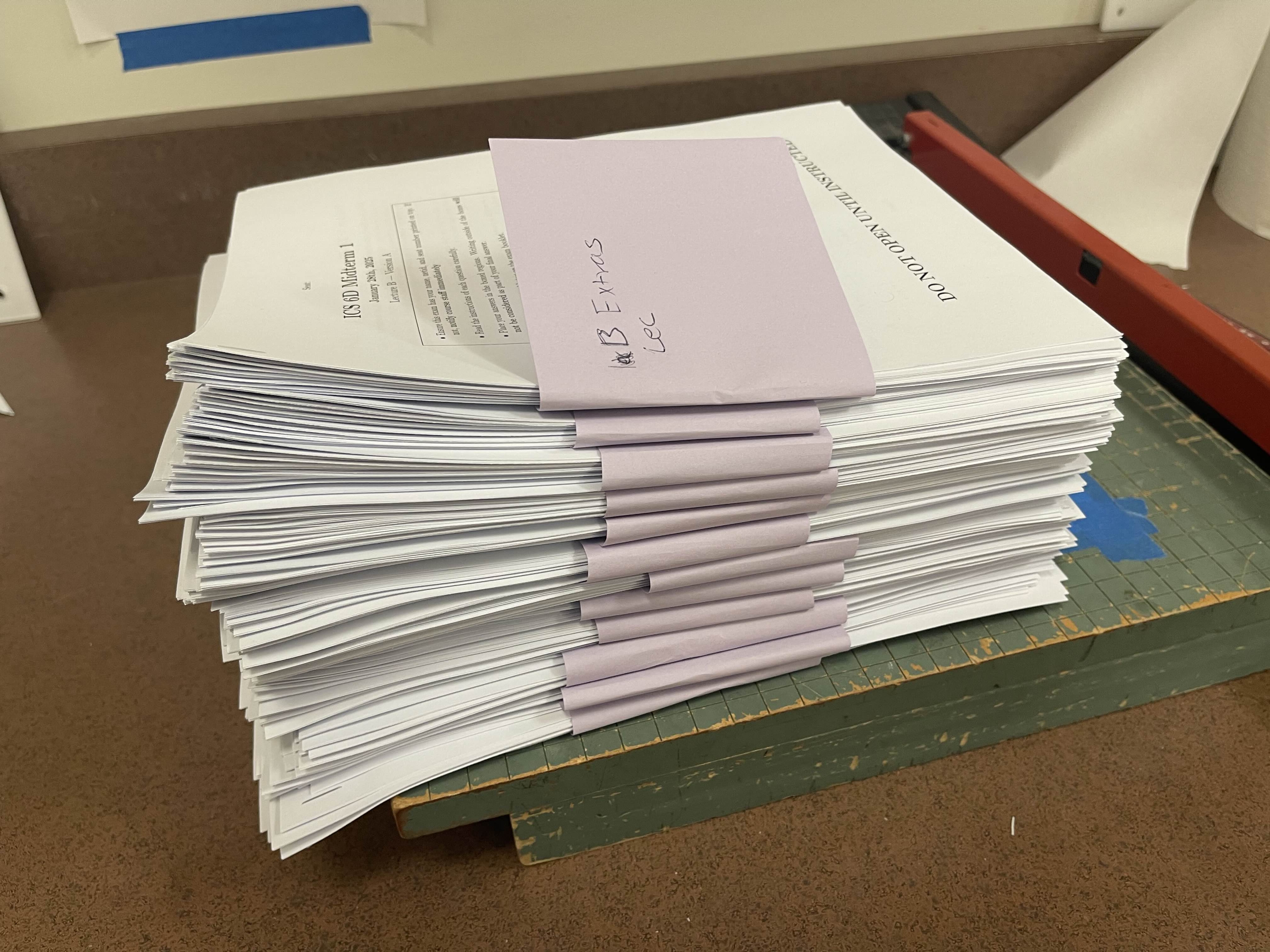
Organized Exams as produced by my exam automation script for discrete mathematics.